Past North African climate
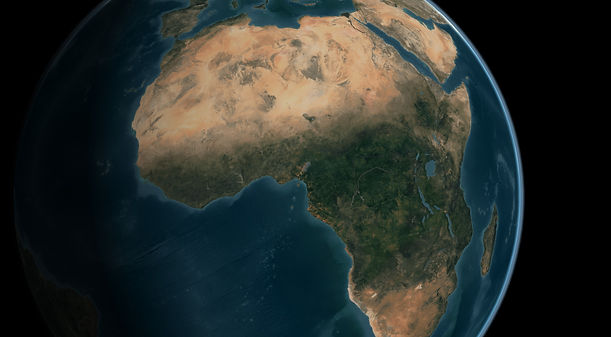
Image source - www.nasa.gov
Modern North African landmass hosts the world's largest hot desert, the Sahara. The Sahel region south of the Sahara marks the transition from desert conditions to tropical savanna and subsequently the tropical West African forest region. The savanna zone marks the modern northward extension of the African monsoon front.
As explained by the Milankovitch Theory, the solar energy input to the Earth surface (insolation) changed through time cyclically, due to the changes in Earth's orbital parameters (eccentricity, axial tilt and precession). North Africa experienced astronomical precession-driven wet-dry cycles at least over the past 11 million years. During the wet periods (increased Northern Hemispheric summer insolation), the African monsoon front migrated toward the Sahara, modifying the hydrology of the region to established vast fluvial systems with interconnected lakes. This transformation caused migration of both early human ancestors and animals toward the otherwise inhospitable arid landmass.
Green Sahara Periods (GSPs)
Precession driven northward African monsoon front migration enhanced vegetation cover over the Sahara, establishing GSPs (or African humid periods; AHPs). Due to the intensified monsoon, and the establishment of paleoriver systems other than the Nile, freshwater runoff to the Mediterranean increased substantially. The consequent surface buoyancy increase caused Mediterranean stratification, initiating a 5-12 thousand-year-long phase of bottom anoxia. Anoxic conditions preserved sinking organic matter as dark layers (sapropels) in the Mediterranean sediment record. Thus, Mediterranean sediments are excellent archives of past GSP occurrence, and serve as a chronological marker.
In this article, we develop the first-ever continuous multi-proxy paleoclimate reconstruction from the Mediterranean basin, using ocean drilling program (ODP) Site 967 sediment record. Using X-ray fluorescence scanning and stable oxygen isotope ratio data, we show that the Mediterranean organic carbon burial intensified around 3.2 million years ago (Myr), immediately following the initiation of Mid-Pliocene glaciation.
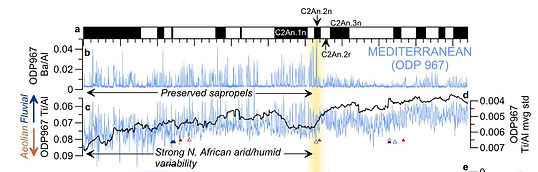

ODP 967 sediment record, with sapropels as dark layers
Video source- PBS Eons | www.youtube.com/@eons
A pan-North African humid period (pan-NAHP) during the Pliocene
Stable oxygen isotope data from ODP Site 967 implies a long-term increase in monsoon runoff since 3.8 Myr that lasted until the M2 glaciation (3.3 million years ago; the first globally-recognized glacial event at the onset of Northern hemispheric cooling). This period coincides with an absence of sapropels across the eastern Mediterranean, suggesting substantially reduced lan surface erodibility (hence, nutrient runoff to the Mediterranean which usually aided sapropel deposition).
In this project, climate simulations for the Pliocene were designed by modifying PRISM4 boundary conditions with changed ice sheet extent and greenhouse gas concentrations, in collaboration with Dr. David Hutchinson (University of New South Wales). In this article, we show that the intensification of Mediterranean organic carbon burial was driven by enhanced North African erodibility after 3.3 Myr, due to strengthened atmospheric circulation and a southward shift of the African monsoon front during glacial periods. The preceding pan-NAHP coincides with the first co-occurrence of homininc (australopithecine) fossils in East Africa and the Chad Basin, suggesting that expanded vegetation may have allowed the earliest known early hominin migration event.

Simulation results showing a) precipitation change and b) mean meridional strem function change from Early Pliocene to the M2 glaciation